
“You need buy-in, however you get it”
At Oasis Academy Coulsdon, part of Oasis Academy Trust, replacing a patchwork of homework platforms with one shared system was just the start. The school’s experience shows what it takes to make a shared approach work in practice, from getting staff on board and establishing clear ownership to using data to spot where students need more support.
Setting expectations and sustaining momentum
“Before Educake, we had a complete mishmash of platforms” says Ben Hodges, Senior Deputy Principal. “It was confusing for everyone. Teachers wanted everything in one place for accountability, and parents were saying things like, ‘It’s too confusing to go here for this and there for that.’ Students felt the same. We needed one consistent system.”
Oasis Academy Coulsdon introduced Educake in October, using the run-up to Christmas as a soft launch before a more formal launch in January. This gave them time to gather feedback, communicate with staff, students and parents, and establish routines through regular reminders.
In the first few week, Ben ran the routine himself:
“I emailed daily reminders like, ‘Today is Science – let me know when you’ve set your Educake.’ It needed that hand-holding at the start.”
His advice to other schools:
“You need buy-in, however you get it. And you need one person overseeing the whole thing. If you spread responsibility across multiple people, it won’t work. Once you let it drop, it drops. You need relentless consistency at the start – daily reminders, clear expectations, and someone driving it.”
Making the most of a shared picture
With everyone on one system, Oasis Academy Coulsdon can see homework engagement across subjects and year groups, including how pupil premium (PP) students compare with their peers.
“Previously there was a massive disparity between PP and non-PP homework completion,” says Ben. “This year we’ve closed the gap and in some areas there is no gap.”
To monitor progress, Ben built a spreadsheet comparing pupil premium students’ completion with targets and year group averages. He reviews it every Wednesday to identify where follow-up may be needed.
“It took a while to set up, but now it takes 20 minutes a week and it’s incredibly data-rich. Heads of department use it too.”
The school uses this information to follow up with individual students when engagement drops and recognise effort through assemblies and competitions.
The same information helps at department level. In science, homework is set centrally for the whole department, so Ellie Hooper, KS3 Science Lead, can see across every class:
“It allows me to see where cohorts are doing well or struggling, identify whether teachers need CPD, and spot where students may need intervention,” says Ellie Hooper, Head of KS3 Science.
Reducing workload without losing oversight
A consistent approach needs to be manageable for the people delivering it. At Oasis Academy Coulsdon, moving away from paper homework and multiple platforms has reduced repetitive tasks, while automated marking gives teachers quicker feedback on student understanding.
James Simmonds, Head of Geography, estimates that his marking workload has fallen by about 90%. “All I’ve got to do now is choose the questions I want,” he says. “Students complete them, they get feedback and I get feedback.”
The change means teachers can spend less time on repetitive marking while retaining access to information about how students are performing. As James explains, this information can also help him adjust lesson planning and address misconceptions.
Data only matters if it improves teaching
Victoria Holt, Head of History, says that when a large proportion of students share a misconception, “instead of just moving forward blindly, thinking that everybody has got it, we can pause for a moment, address that misconception, reteach and then use Educake again to re-quiz to see where that teaching has landed.”
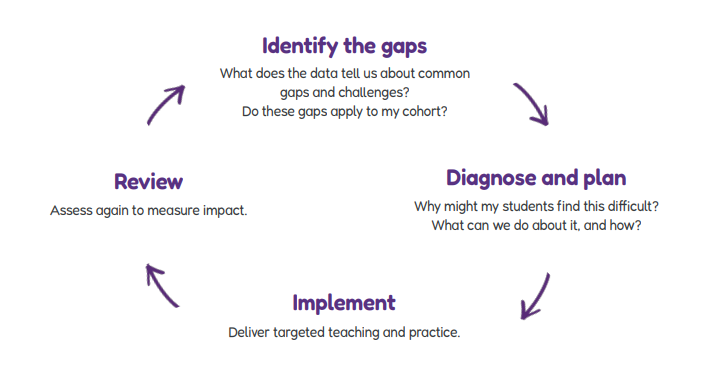
This creates a link between homework, classroom teaching and subsequent assessment. Rather than treating completion as the end goal, teachers can use the information to identify gaps, revisit difficult topics and check whether students have understood them.
It isn’t happening everywhere yet and Ben is upfront about that. Asked whether the data has informed intervention and curriculum decisions, he says: “Sporadically. That’s the next phase, deeper analysis of strong/weak areas to inform planning. Some departments do this already; others don’t.”
Questions for your trust or school
Who owns it?
Who is responsible for making the approach work in each school, and what keeps momentum going after launch?
Can you see who it’s reaching?
Can school and trust leaders see where the gaps are, including between student groups, and use that to target support?
How do you turn consistent information into improvement?
How could insights from individual students, classes and year groups better inform professional development, interventions and curriculum planning?